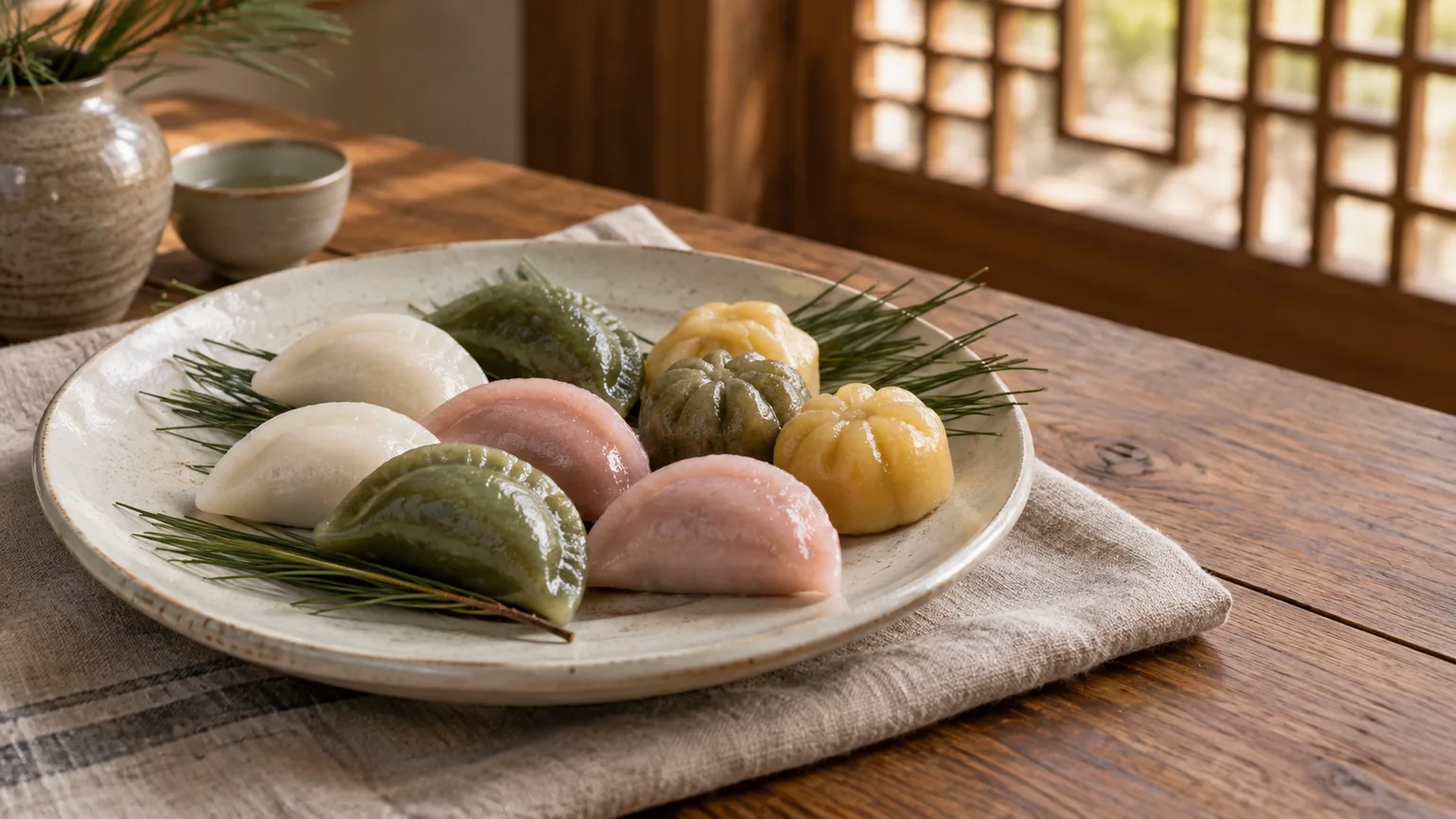
At a Chuseok market stall, the prettiest songpyeon is not necessarily the one you will enjoy eating. A pink or green rice cake may tell you something about the dough, yet the hidden filling determines whether the first bite tastes nutty, earthy, or plainly sweet. Ask what is inside before choosing by color.
Start with the filling
Songpyeon (송편) is a small rice cake most closely associated with Chuseok, Korea's harvest holiday. The dough is usually made from non-glutinous rice flour, filled, shaped, and steamed over pine needles. The 2026 VISITKOREA Chuseok guide names soybeans, sesame seeds, and red beans among the common fillings. Chestnut is another established choice in the agency's broader Chuseok food overview.
Those names are more useful than a flavor label such as “sweet.” Sesame filling is often ground and mixed with a sweetener, giving it a concentrated, nutty taste. Bean fillings vary: some keep the beans fairly distinct, while red bean is more likely to appear as a paste or soft crumble. Chestnut can retain small pieces and a mild sweetness. A mixed box is the simplest introduction if everyone eating it is comfortable with the ingredients.
The outside color is a weaker clue. Mugwort can make the dough green, while gardenia, omija, pumpkin, or other ingredients may produce yellow, pink, or deeper tones. Modern shops also sell decorative assortments whose colors are chosen for presentation. Green therefore does not guarantee one filling, and white does not mean unfilled.
At a shop, ask “I songpyeon-eun museun so-yeyo?” (이 송편은 무슨 소예요? “What filling does this songpyeon have?”). The word so (소) means the filling. Pointing to the piece or box while asking is perfectly adequate.
The half moon and the pine needles
Songpyeon's place at the Chuseok table is tied to the harvest rather than to a single origin story. Official tourism material describes families preparing the rice cakes together, using the season's rice and placing songpyeon among foods offered during ancestral rites. That combination of harvest produce, household labor, and ritual use explains why the rice cake became one of Chuseok's most recognizable foods.
The familiar crescent is usually explained as a waxing moon, a form associated with growth and future prosperity in contemporary official guides. It is useful context, but it should not become a test of authenticity. Regional versions may be rounder, shell-shaped, flower-shaped, or larger than the neat bite-size crescents commonly sold in Seoul.
Pine needles are functional as well as symbolic. Songpyeon is laid over them in the steamer, and their fragrance transfers to the rice cake. The Korean name itself begins with song (송), meaning pine. A gentle resinous aroma is therefore part of the traditional method; it is not a flavored syrup added to the filling. The scent can be faint in a packaged product that has traveled or been refrigerated.
Regional songpyeon does not follow one mold
A Korea.net survey of regional varieties gives a useful map of how broad the category is. Seoul and Gyeonggi are associated with small five-color songpyeon. Gangwon traditions use potato, Chungcheong versions may use pumpkin, and Jeolla is known for mosi songpyeon, made with ramie leaf. The same source also records flower and seashell forms and northern styles made with frozen potato.
These differences affect more than appearance. Potato or pumpkin changes the dough itself; ramie leaf changes its color and aroma; a shell or flower form belongs to a different shaping tradition. “Regional” on a shop sign should still be read as a description to check, not a guarantee that the product was made in that province or follows one fixed recipe.
For a first tasting, there is no need to hunt down every variety. A fresh local assortment with clearly identified fillings is more informative than a large souvenir box chosen only for its colors. Regional styles become worth seeking when the seller can name the dough ingredient or tradition behind them.
Allergy questions need more than a glance
Songpyeon can look simple while containing ingredients that matter to people with allergies. Established fillings include soybeans, sesame, red beans, and chestnuts, and sesame oil may be brushed on the surface after steaming. Individual recipes and shared equipment add further uncertainty. Do not assume that a white rice exterior makes the product safe.
For packaged food, read both the ingredient list and the separate allergen statement. Korea's Ministry of Food and Drug Safety requires labeling for a defined list that includes soybeans, peanuts, walnuts, and pine nuts. The same rules address warnings when allergen-containing and allergen-free products share manufacturing equipment.
Sesame deserves a direct question. It is a common songpyeon filling, but it is not named on the current Korean mandatory-allergen list shown on the ministry's English labeling page. If sesame is a concern, ask “Kkae deureogayo?” (깨 들어가요? “Does it contain sesame?”). For a severe allergy, also ask about shared tools and steamers, or choose a sealed product whose manufacturer can answer clearly. Loose rice cakes at a market may have no English label.
Useful ingredient questions include:
- Daedu deureogayo? (대두 들어가요?) — Does it contain soy?
- Ttangkong-ina hodu deureogayo? (땅콩이나 호두 들어가요?) — Does it contain peanuts or walnuts?
- Gateun dogureul sayonghaeyo? (같은 도구를 사용해요?) — Do you use the same tools?
Someone with a medically diagnosed allergy should not rely on color, a verbal guess, or the absence of a front-label warning. If the seller cannot identify the filling and shared-equipment risk, skip that assortment.
Buying it during Chuseok
Traditional markets and neighborhood tteokjip (떡집, rice-cake shops) are the most straightforward places to look. The 2026 holiday guide also points visitors toward seasonal cultural programs, including hands-on food experiences. Availability is uneven because many businesses close or shorten hours over the holiday, so check the shop's notice before making a special trip.
Fresh songpyeon is best treated as perishable food. Ask how it should be stored and when it was made; follow the seller's instructions rather than assuming every rice cake keeps the same way. Chilled rice cakes often firm up, and a seller may recommend brief reheating or steaming.
Songpyeon may also arrive as one part of a larger holiday spread. If you are eating with a Korean household, the shared-table etiquette guide covers the serving and utensil habits that are easy to miss. Travelers arranging a meat-free meal can use the namul and Korean vegetarian food guide for the savory dishes around the rice cakes, while still checking each recipe individually.
If you are tasting songpyeon for the first time, choose a small mixed box with named fillings. Try one while it is still fresh enough to notice the soft rice dough and light pine aroma. That is a better introduction to the Chuseok food than selecting the largest decorative box and discovering the ingredients only after opening it.