Exhibition details checked September 23, 2026. The National Museum of Korea lists The Korean Table: Food, Nature, and Life in Special Exhibition Gallery 2 through October 25, 2026.
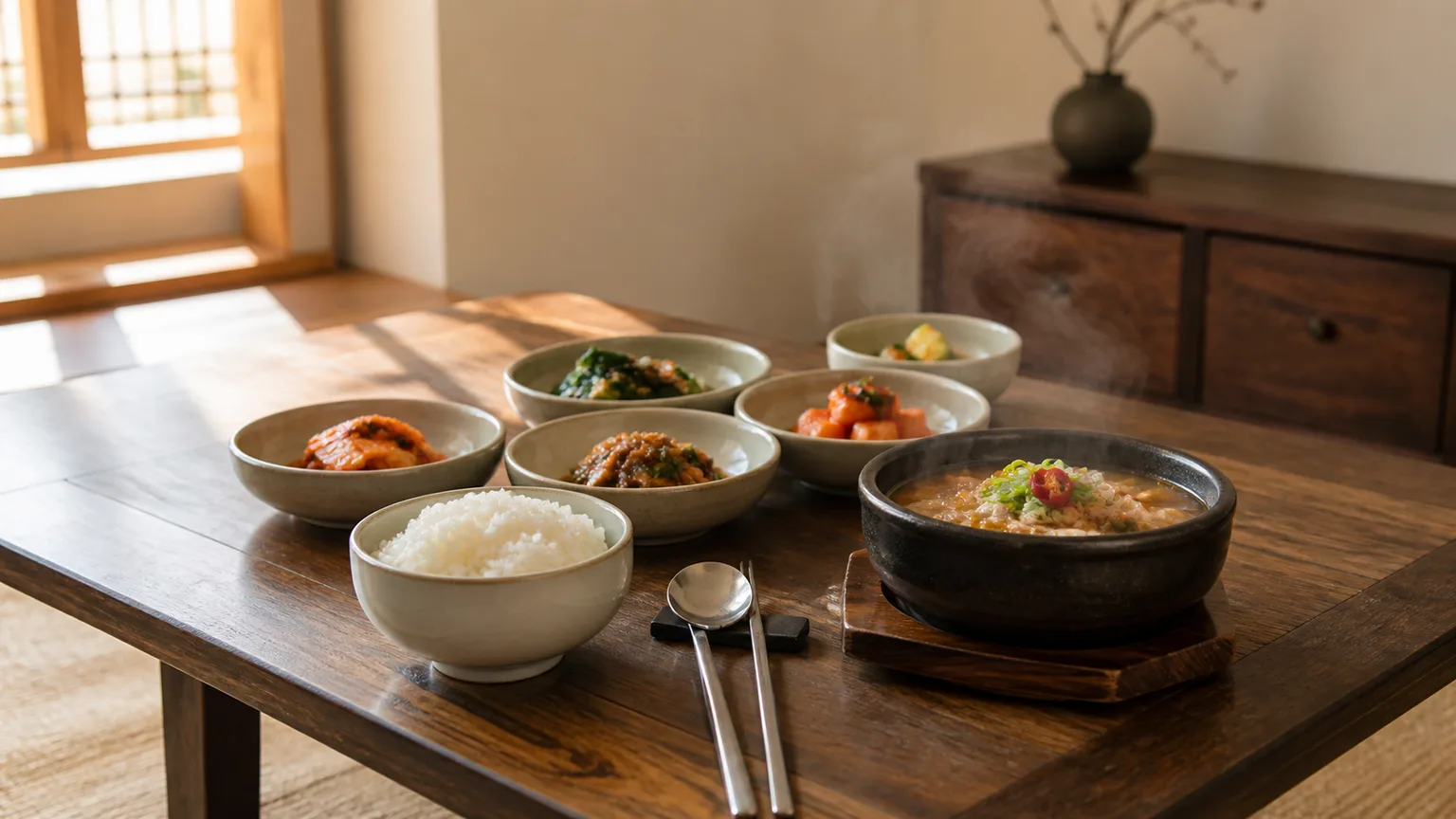
At a Korean meal, rice and soup are usually individual while banchan and many main dishes sit in the middle for everyone. Use the serving utensils when provided, take a modest amount, and follow the table’s pace rather than treating every plate as your own portion.
The first surprise at a Korean restaurant is often spatial. Your rice, soup, spoon, and chopsticks sit in front of you, but kimchi, vegetables, grilled meat, and other dishes may arrive for the table. You are not expected to divide every side dish before eating.
What belongs to you, and what belongs to the table?
The Korea Tourism Organization describes the standard arrangement as han sang charim: rice and soup in front of each diner, with a main dish and several banchan around them. The small plates are there to be combined with bites of rice in whatever order you like. The vegetarian namul guide explains why a vegetable side dish is not automatically free of fish or meat ingredients.
That does not mean that every Korean meal follows one rigid plan. A bowl of bibimbap is individual. Barbecue, hot pot, fried chicken, and many restaurant set menus are shared. If the layout is unclear, watch where the server places the dish or ask, “Is this for sharing?”
Five habits that make the meal easier
1. Start with a small portion
Take one or two pieces from a shared plate, then return for more. This keeps the dish accessible and avoids building a private pile from food the table ordered together.
2. Use the utensil that came with the dish
Tongs, scissors, a ladle, or a serving spoon usually belong to the shared food. Use your own spoon for rice and soup. Korean restaurant spoons do more work than many visitors expect, and there is no problem using one when chopsticks are awkward.
3. Let the grill develop at its own pace
At a barbecue restaurant, staff may cook the meat or tell you when it is ready. If staff are handling the grill, leave the tongs alone unless they invite you to take over. When diners cook for themselves, one person often manages the first batch so that several hands are not moving raw and cooked meat around at once.
4. Look for the self-service station
Extra water and side dishes may be self-service. Other restaurants use a call button, sometimes mounted at the edge of the table, and utensils may be in a drawer underneath. The Korea Tourism Organization’s restaurant guide notes all three arrangements. Check before waving repeatedly for a server.
5. Match the group’s pace
You do not need to perform a ceremony. Pause long enough to see whether everyone has food, especially when a host is ordering or an older relative is at the table. In a casual meal with friends, the atmosphere may be much looser. The people at the table are a better guide than a memorized etiquette list.
A museum stop before dinner
The National Museum of Korea exhibition gives the subject a wider frame without asking visitors to treat every modern meal as an ancient custom. Its official page lists the title, gallery, and run from July 1 to October 25, 2026, and provides an English guidebook.
The museum is at 137 Seobinggo-ro in Yongsan. If you visit, use the exhibition to notice vessels, ingredients, and the arrangement of a table; use the restaurant itself to learn how that particular meal works. Service style changes with the menu, price level, and size of the group.
Questions travelers actually ask
Can I ask for more banchan?
Often yes, and the KTO guide says extra side dishes generally do not carry an additional charge. Some restaurants make refills self-service, while premium or unusually large items may be handled differently. Ask before assuming.
Do I need to tip?
No tip is expected at an ordinary Korean restaurant. Pay the amount shown at the counter or table terminal.
What if I cannot use metal chopsticks?
Use the spoon where it works, or ask whether a fork is available. Struggling through the meal is not a sign of respect.
At the table
Keep your rice and soup close, leave shared plates within everyone’s reach, and take a little at a time. That is enough to get through most first meals without turning dinner into an etiquette test. If the restaurant is hard to find in English, save its Korean name with the NAVER Map English guide.