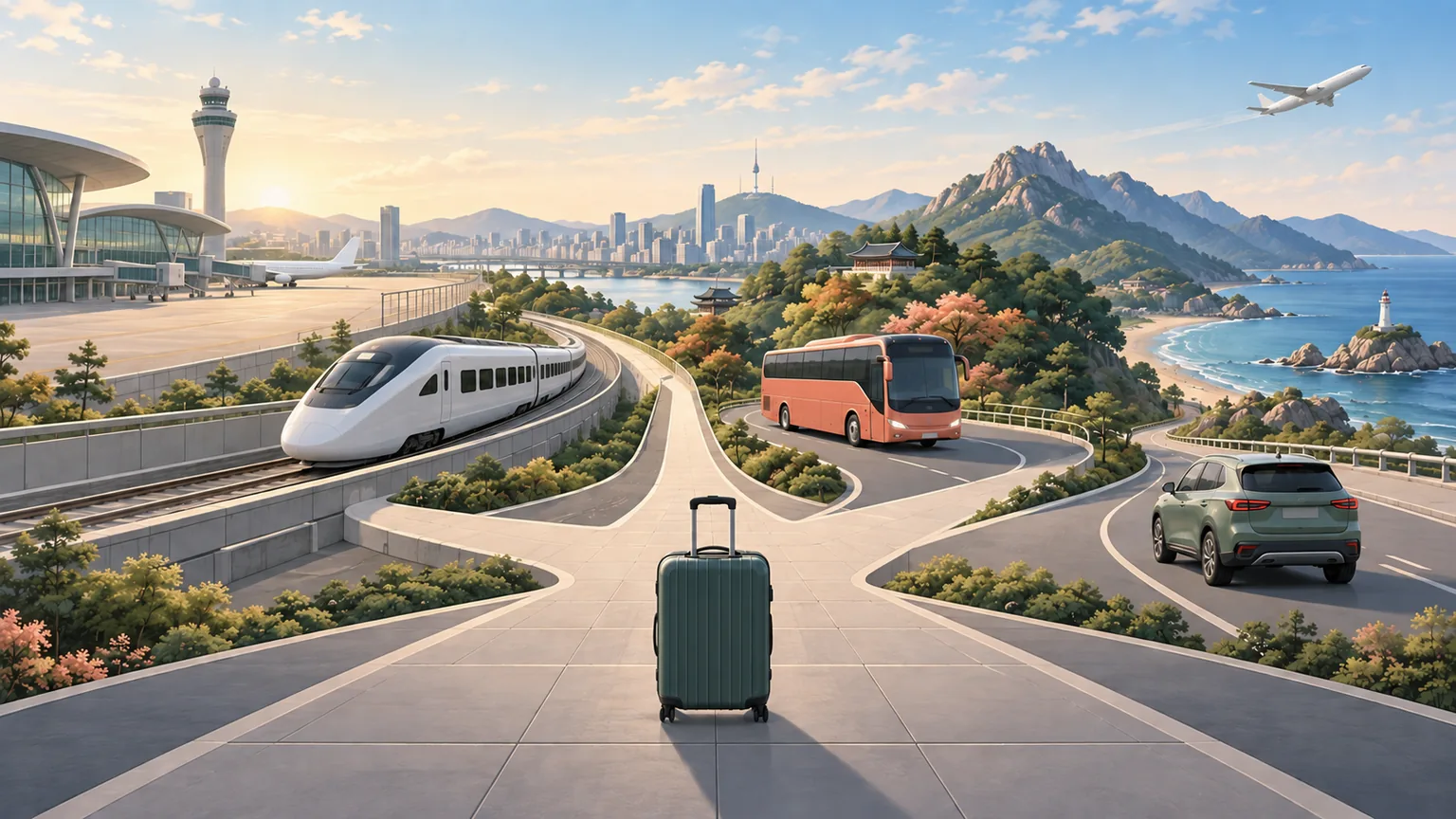
I live in Korea and travel to regional cities often for work, yet I still have to think about the most efficient route. KTX is usually the fastest and easiest answer. On some days a domestic flight works better. If I want to visit several places between the airport and my final city, I drive. When I would rather sit down once and avoid hauling luggage through a transfer, an udeung or premium coach can be the calmer journey.
The useful handoff may be outside Seoul
Travelers often search for an airport-to-Seoul route first and then plan the rest of Korea as a second journey. That detour is not always necessary. Incheon International Airport currently tells arriving passengers that they can take the KTX Airport Limousine to Gwangmyeong Station and transfer to KTX there. The airport lists the limousine at 20-to-30-minute intervals during its operating window, though the actual connection still depends on your terminal, arrival time, and train reservation.
Gwangmyeong Station is especially useful for KTX trips heading south or southwest. It keeps you away from central Seoul and its traffic. Seoul Station remains important for routes such as Gangneung and when its timetable gives you a much cleaner connection. AREX links both Incheon Airport terminals with Seoul Station, while the all-stop train also reaches Gimpo Airport.
There is another exit from the airport: stay on the road. The official Incheon Airport regional bus search is divided into Gangwon, Jeolla, and Gyeongsang destinations and links to intercity reservations. A bus that leaves two hours later may still beat a rail route if it removes two transfers and arrives closer to your hotel.
A first route to check for each city
This table is a starting point, not a permanent timetable. Search your arrival date with a realistic immigration and baggage buffer, then compare when each option reaches the final neighborhood.
| Destination | Check first | Compare it with | The detail that can change the choice |
|---|---|---|---|
| Busan | Airport limousine to Gwangmyeong Station, then KTX | Direct regional bus; a Gimpo domestic flight only when the schedule and your Busan destination justify the airport transfer | Busan Station is central; Gimhae Airport may still leave a substantial city transfer |
| Daegu | Gwangmyeong Station to Dongdaegu by KTX | Direct regional bus | Dongdaegu combines rail, metro, and buses in one transport area |
| Gwangju | Gwangmyeong Station to Gwangju-Songjeong by KTX | Direct regional bus or a Gimpo flight on a favorable schedule | Gwangju-Songjeong Station and the city center are not the same destination |
| Jeonju | Compare Gwangmyeong KTX with the direct airport bus | Rental car for a wider Jeolla itinerary | The bus terminal or Jeonju Station may be more convenient depending on the accommodation |
| Gangneung | Direct regional bus or AREX to Seoul Station followed by KTX | Rental car for an east-coast trip with several stops | A short wait for a direct coach may be easier than crossing stations with luggage |
| Jeju | A protected connecting flight, or an AREX transfer to Gimpo Airport for a separately booked domestic flight | An overnight near Gimpo if the connection is too tight | Separate tickets leave you responsible for immigration, baggage, terminal transfer, and a missed onward flight |
The table favors routes with a clear handoff. A train may be faster after departure, but an hour spent reaching the station can erase that advantage. A direct coach can look slow on paper and still deliver the easier day.
KTX usually wins on a one-city trip
For Busan, Daegu, Gwangju, and many Jeonju departures, I would check Gwangmyeong before traveling into Seoul. Search the actual airport-limousine arrival and the train departure as one connection, not as two independent best-case times. Give yourself room for immigration, baggage collection, finding the bus stop, and walking through Gwangmyeong Station.
Use the official KORAIL English site to check KTX inventory and station names. Holiday weekends and the Korean Lunar New Year or Chuseok period need special care because the reservation process and seat availability can change. Do not board the airport limousine simply because “KTX is faster” and hope a suitable seat will be waiting.
Gangneung pulls the route in a different direction. Seoul Station can provide the cleaner rail connection, so AREX plus KTX may make more sense than Gwangmyeong. The total route still has to compete with a coach leaving directly from the airport. With two large suitcases, one less transfer has real value.
The bus lets you stop handling the luggage
Korea has two overlapping long-distance coach systems: express buses and intercity buses. The Korea Tourism Organization's current express and intercity bus guide explains that the networks serve major cities as well as regional destinations that rail does not reach directly. Airport routes and city-terminal routes are not interchangeable, so search “Incheon Airport T1” or “Incheon Airport T2” as the real origin.
The Korean word 우등 (udeung) indicates a roomier coach class. A premium bus goes further with a more private reclining seat and, depending on the vehicle, individual charging and entertainment equipment. The Ministry of Land, Infrastructure and Transport says free Wi-Fi was opened across the routes and vehicles of eight express-bus operators in April 2025.
I like this option when I have no reason to rush through a station. Once the suitcase is in the luggage compartment, I can stay in one seat until the destination terminal. The important catch is frequency: a direct airport coach with a long wait can be less useful than a quick Gwangmyeong transfer. Check both before buying either ticket.
Domestic flights solve a different distance problem
Jeju is the obvious flight case. If the international itinerary does not include a protected onward connection, travelers commonly move from Incheon to Gimpo International Airport and start a separate domestic journey. Gimpo's official domestic check-in information lists several Korean carriers operating from its domestic terminal.
A flight can also be worth comparing for Busan or Gwangju, but the airfare is only one part of the decision. Add the trip from Incheon to Gimpo, domestic check-in and baggage time, and the transfer from the arrival airport into the city. KTX often becomes simpler because the main station is closer to the place you actually want to reach.
Do not build a short self-transfer around the published arrival time of the international flight. Delayed landing, immigration, and baggage are your risk when the tickets are separate. If the same-day margin is uncomfortable, one night near Gimpo is cheaper than improvising after a missed domestic departure.
Driving makes sense when the road is part of the trip
For a straight trip to a city center, rail or bus usually saves effort. A rental car becomes useful when the route includes several small cities, a rural stay, coastal stops, or luggage that would be awkward to move repeatedly. Incheon Airport lists rental-car desks in both passenger terminals. Confirm the company's license requirements, driver age rules, insurance, toll method, and return location before reserving.
I tend to drive when the destination is roughly 200 to 300 kilometers from Seoul. Part of the appeal is the highway stop. A Korean expressway service area is a 휴게소 (hyugeso), and I enjoy seeing which food each one is known for instead of treating the stop as dead time. The Korea Tourism Organization's driving guide notes that major rest areas combine food courts, snack shops, regional products, restrooms, and fuel facilities.
That pleasure does not make a rental car the right choice after every long-haul flight. If the driver is exhausted, take the train, coach, or an airport hotel and collect the car after sleeping. Driving is valuable when it opens the itinerary, not when it turns arrival day into an endurance test.
Book the connection before the attraction
- Write down your terminal, scheduled landing time, and the earliest departure you can reach without assuming perfect immigration and baggage timing.
- Compare one direct airport bus with one rail route through Gwangmyeong or Seoul. For Jeju, compare a protected flight connection with a self-transfer through Gimpo.
- Check the destination end. A station, bus terminal, and domestic airport may place you in very different parts of the same city.
- Reserve the long-distance seat, then save the exact terminal and hotel pins. The NAVER Map English-search guide shows how to recover a Korean station or terminal listing when the English name fails. If your phone plan is still undecided, compare a Korea eSIM with pocket Wi-Fi before depending on those saved pins.
- If the final workable departure leaves no margin, sleep near the airport and travel in the morning.
After a long international flight, the best route is often the one with one confirmed seat and the fewest uncertain handoffs.