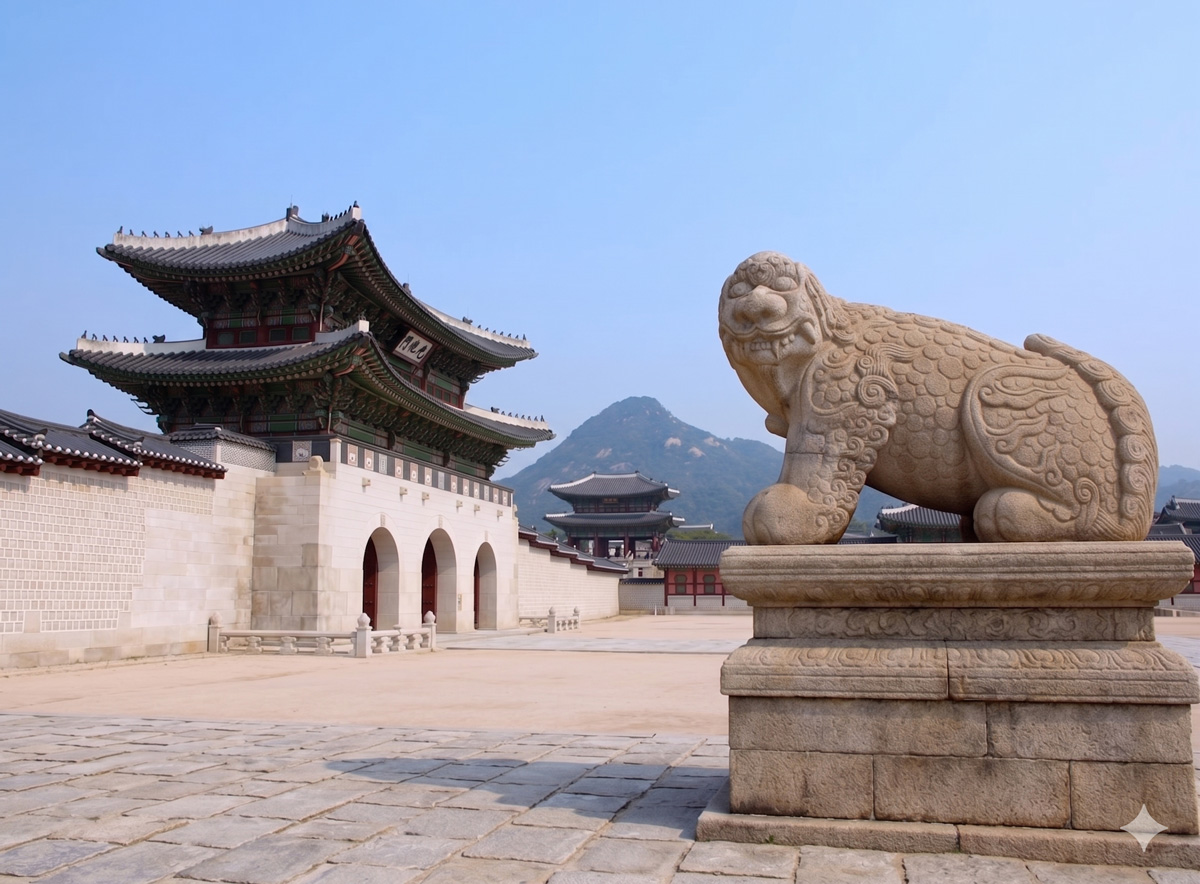
The Seoul Metropolitan Government’s hiking guide identifies Haetae as an imaginary animal and discusses the statues’ location, while the Academy of Korean Studies’ Seoul guide explains Haechi’s guardian symbolism.
Two stone Haetae stand south of Gwanghwamun, the main gate of Gyeongbokgung Palace, facing toward Mt. Gwanak. Their placement connects the mythical animal with law, fire protection, and the approach to the royal precinct.
These are the Haetae (해태), also called Haechi (해치), mythical beasts from East Asian legend associated with the ability to see straight through to the truth of any matter, distinguishing right from wrong, innocence from guilt.
The statues were moved during the colonial period, survived the Korean War, and returned during later reconstruction work.
A symbol of judgment
Ancient Chinese texts describe the Haetae as a creature resembling an ox or a sheep with a single horn atop its head and luminous, penetrating eyes. According to legend, when two people fought, the Haetae would charge and gore the dishonest one with its horn. When people argued, it would bite the liar. Because of this nature, the creature became inseparable from the concept of law itself.
In Korea, the connection between the Haetae and justice took on institutional weight during the Joseon Dynasty (1392–1897). The Saheombu (사헌부), the royal inspectorate charged with monitoring government officials and enforcing the law, adopted the Haetae as its official symbol. The chief inspector, the Daesaheon, wore court robes embroidered with the creature on his chest badge, a visual declaration that he served as the king’s eyes against corruption.
Anatomy of a Myth
The Korean Haetae differs from its Chinese counterpart. Its body is covered in scales rather than fur. It has wing-like feathers beneath its forelimbs. A bell hangs from its neck. It is said to dwell near marshes in summer and retreat to pine forests in winter. In English, it is sometimes rendered as “the unicorn-lion.”
Why the statues face south
The Gwanghwamun statues also carry a fire-protection meaning.
In pungsu (풍수), the Korean system of geomancy, Mt. Gwanak (관악산) looms to the south of Seoul with ridgelines that resemble leaping flames. For centuries, Koreans attributed the palace’s frequent fires to this mountain’s intense fire energy radiating northward into the heart of the capital.
When Heungseon Daewongun, the powerful regent and father of King Gojong, rebuilt the long-ruined Gyeongbokgung beginning in 1865, the reconstruction included several symbolic protections. Bronze dragons were sunk into the reflecting pool at Gyeonghoeru Pavilion. Water-character talismans were sealed inside roof beams. And a pair of massive stone Haetae were carved and placed on Yukjo Street (육조거리), the boulevard of six central ministries, about 80 meters in front of the palace gate, their gaze locked on the fiery mountain.
The placement joined two established associations: protection from the fire energy attributed to Mt. Gwanak and the Haetae’s link with law and official conduct.
Colonial displacement
After Japan annexed Korea in 1910, the colonial government dismantled much of the Gwanghwamun area and built the Japanese Government-General Building inside the palace grounds.
The Haetae statues were uprooted from Yukjo Street and repositioned as ornamental objects in front of the colonial headquarters. What had been a sacred symbol of Korean sovereignty and justice was reduced to decoration for the seat of foreign power. In 1923, the Woldae, the ceremonial stone platform in front of Gwanghwamun, was demolished entirely to make way for a Japanese tramway line.
An Jungsik’s 1915 painting records Gwanghwamun and the Haetae during this period.
Reconstruction and restoration
Gwanghwamun was destroyed during the Korean War and rebuilt in reinforced concrete in 1968. The Haetae returned to the gate area, although their precise pre-colonial positions were still uncertain.
Heungseon Daewongun rebuilds Gyeongbokgung and commissions the Haetae statues, placing them on Yukjo Street facing Mt. Gwanak.
Japanese colonial government demolishes parts of Gwanghwamun, moves the Haetae to decorate the Government-General Building, and destroys the Woldae platform.
The Korean War destroys Gwanghwamun. The Haetae survive but are left without a proper home.
Gwanghwamun is rebuilt in concrete. The Haetae return to the gate area but at an imprecise location.
The concrete gate is demolished for historically accurate wooden restoration. The Haetae are temporarily removed once more. Researchers use archival photographs and image analysis to estimate their original pre-colonial positions.
On Liberation Day, the restored wooden Gwanghwamun is unveiled. The Haetae resume their watch.
The Woldae platform is restored for the first time in over a century, completing the palace gate’s recovery.
Korea Heritage Service researchers compared early twentieth-century glass-plate photographs with modern imagery and estimated that the statues had moved roughly 7 to 10 meters from their pre-colonial positions.
Haechi in present-day Seoul
Haechi also appears as a present-day symbol of Seoul. In 2008, the city government designated Haechi as the official mascot of Seoul, a friendly, modern reinterpretation that appears on city buses, manhole covers, and tourism campaigns.
The Gyeongju National Museum guide provides a comparison with guardian and ritual objects from a different Korean period. If Gwanghwamun is one stop in a wider Seoul day, the Namsan Tower guide covers the city landmark farther south.
Stone Haetae also stand before the National Assembly, the Supreme Prosecutors’ Office, and the Supreme Court. Their placement continues the animal’s older association with law and official conduct.
At Gwanghwamun, stand south of the gate and look at the statues in relation to the palace approach and Mt. Gwanak. Their present position makes the history of removal and restoration visible in the same place.